
Tools
Whiteboards, canvas tools, pitch templates: built for a mouse, an eye and eight hours of unbroken concentration.
Note: Something went wrong with your sign-up.Go to the message at the form
Munich · in preparation
An accelerator for disabled founders — sixteen weeks, online, no fee.
Length
16 weeks
From the kick-off to Demo Day, every team on the same beat.
Time
About 2 days a week
One programme day, plus preparation and follow-up.
Place
Online
In person only for the kick-off and Demo Day, both in Munich.
Cohort
Up to 10 teams
They start together and give each other feedback every week.
Mentoring
8 sessions
One to one, every two weeks, with someone who fits your team.
Week 10
Assistance & applications
A block of its own for the questions no other programme asks.
Week 16
Demo Day
In front of investors, partners and the press. Before that, in week 8, an internal pitch.
Cost
€0 · 0%
Partners and, later, software licences carry the cost — not the teams.
Looked up, not claimed
Nobody counts how many disabled people start a company in Germany. Not roughly, not imprecisely — not at all. I searched the three largest German surveys of new business activity for these words:
Behinderung Barrierefreiheit neurodivers ADHS Autismus Legasthenie Schwerbehinderung
My own full-text search of the published reports, as of August 2026. If you know of a survey that does ask, please get in touch.
0hitsDeutscher Startup Monitor 2025
1,846 records searched
0hitsKfW-Gründungsmonitor 2026
50,000 respondents
0attributesNext Generation Report
Full census of all new companies in 2025
What isn't counted doesn't get funded. That has to change.
Four reasons
Whiteboards, canvas tools, pitch templates: built for a mouse, an eye and eight hours of unbroken concentration.
Pension, personal assistance, disability benefits — no standard curriculum answers the questions that come before founding.
An in-person date with not a word about the building is a rejection that doesn't call itself one.
If you have never seen someone like yourself start a company, you don't picture yourself in that role either. And nobody tells you — because the numbers and the stories don't exist.
Access
The programme backs founders, not accessibility products.
Your idea does not have to have anything to do with disability.
How it runs
Accessible means: it works somehow. Fitted means: it was built for you.
If four hours in one go isn't something you can do, the rhythm changes — not the standard you are held to.
Costs nothing
Teams pay nothing, now or later.
Schedule
Week 1 → 16
Programme Your time
One programme day, plus preparation and follow-up. The rest of the week belongs to your company, your job, your therapy or your rest. Across sixteen weeks this is a marathon, not a sprint.
Entrance Lift Toilet Routes
What fills the sixteen weeks
Nine steps from the first problem to a finished pitch, in three phases. At the end of each step there is no tick mark but a result you can show somebody.
Phase 1
Team & vision
Understand the problem
Observe & empathise
Who you are, what you are working on, and who you have really spoken to.
Phase 2
Synthesis & point of view
Develop ideas
Business model
Interviews become patterns, patterns become ideas, and one idea becomes a calculation.
Phase 3
Prototype & MVP
Test & validate
Build & grow
Build something you can put into somebody's hands — and measure what happens.
If a test disproves your hypothesis, you go back to step 4. If the model doesn't hold, to step 6. That is not a setback, it is the normal case.
Every step comes with a tool: a guide, an output, a check.
Guide Output Check
Included in the programme
Eight sixty-minute sessions across the sixteen weeks, online.
Matched to your team — by sector knowledge or by founding experience.
8 × · more on request
Up to ten teams on the same beat: feedback from each other every week, and once a month an evening with guest speakers — in a closed room, not an open forum.
Weekly feedbackMonthly evening
Personal assistance, applications, social law: here these questions are answered by people who do this for a living.
AssistanceSocial lawAccessibility
For each of the nine steps a guide, an output and a check — usable with a mouse, a keyboard, a screen reader or heavy magnification.
MouseKeyboardScreen readerMagnification
In week 16, planned for Munich. Before that, an internal pitch in week 8 — so that the first public one isn't the first one at all.
W8 internal W16 public
Planned: up to twelve more months of support, with check-ins every two to four weeks — also free of charge.
up to 12 months
The programme costs the teams nothing — no fee and no equity, at any point.
No contribution, no success fee, nothing to pay back.
Honestly
This page advertises something that does not exist yet. So that you know what you are signing up for:
Development status
A tool for each of the nine steps — usable with a mouse, a keyboard, a screen reader or heavy magnification.
Draft · sample data
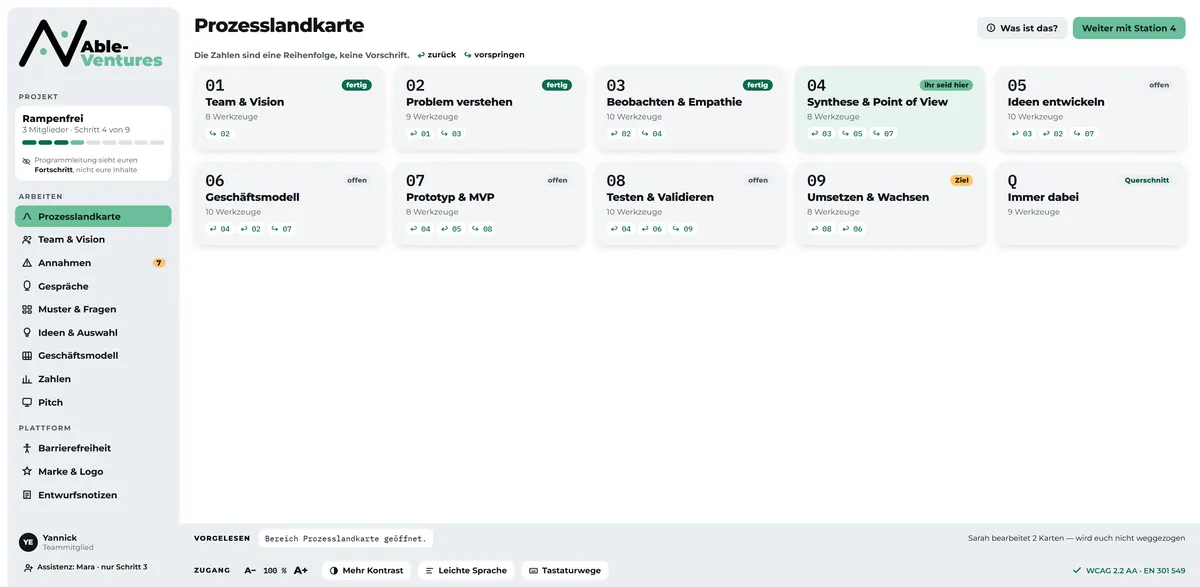
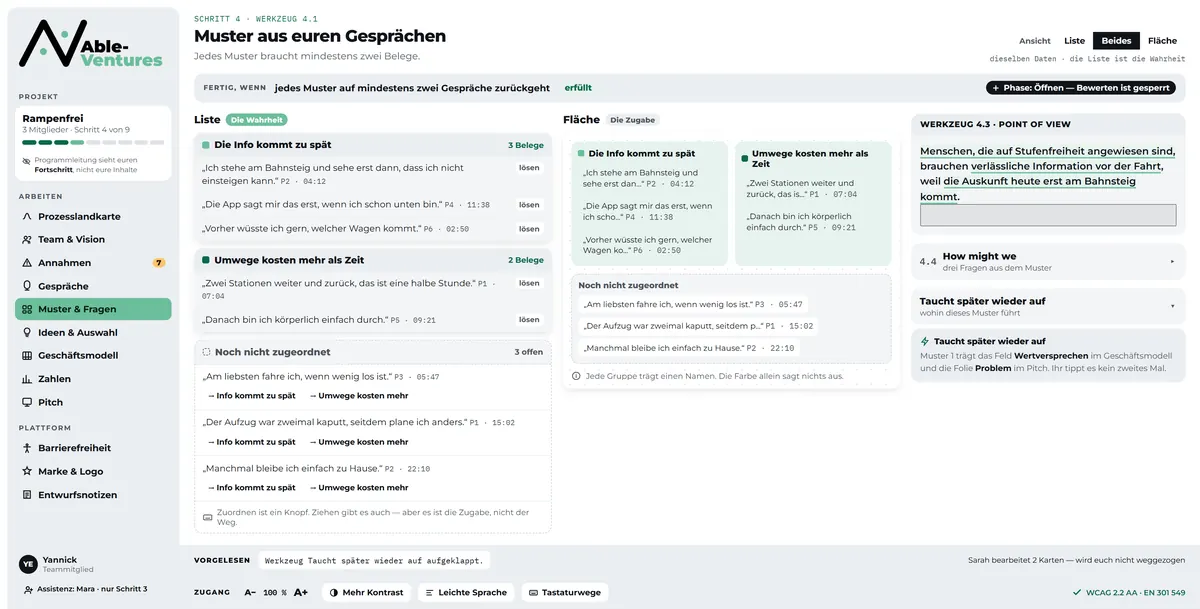
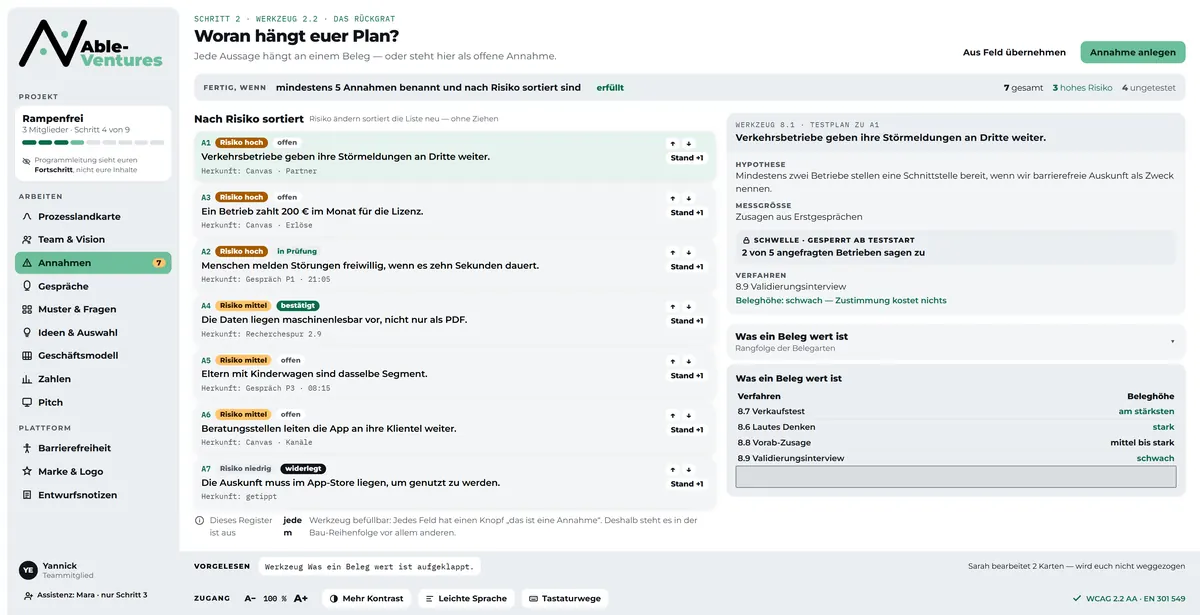
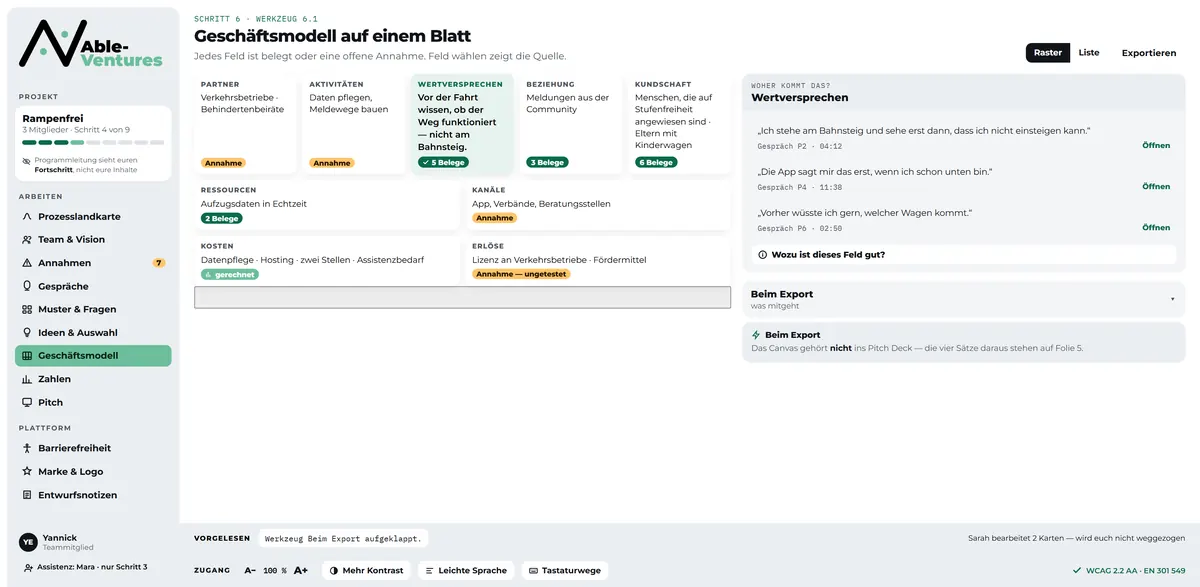
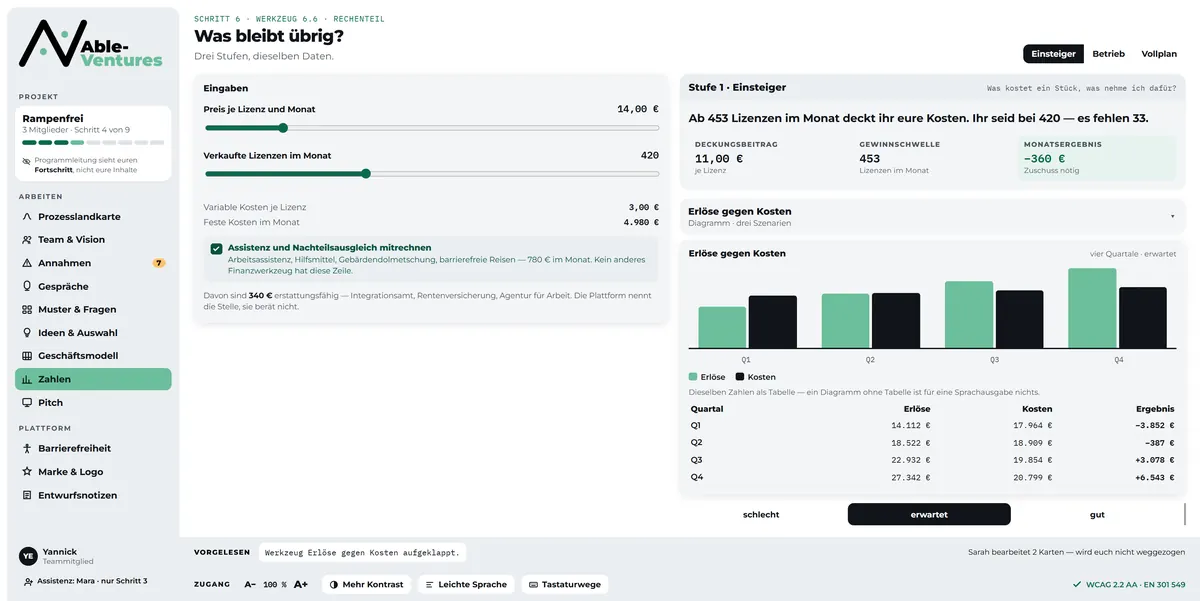
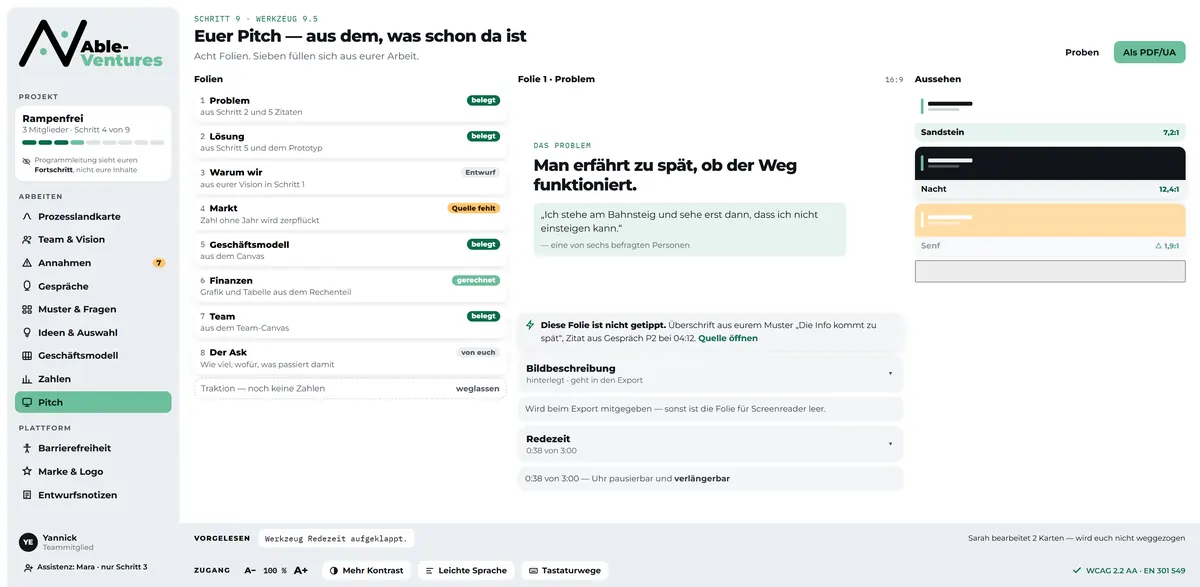
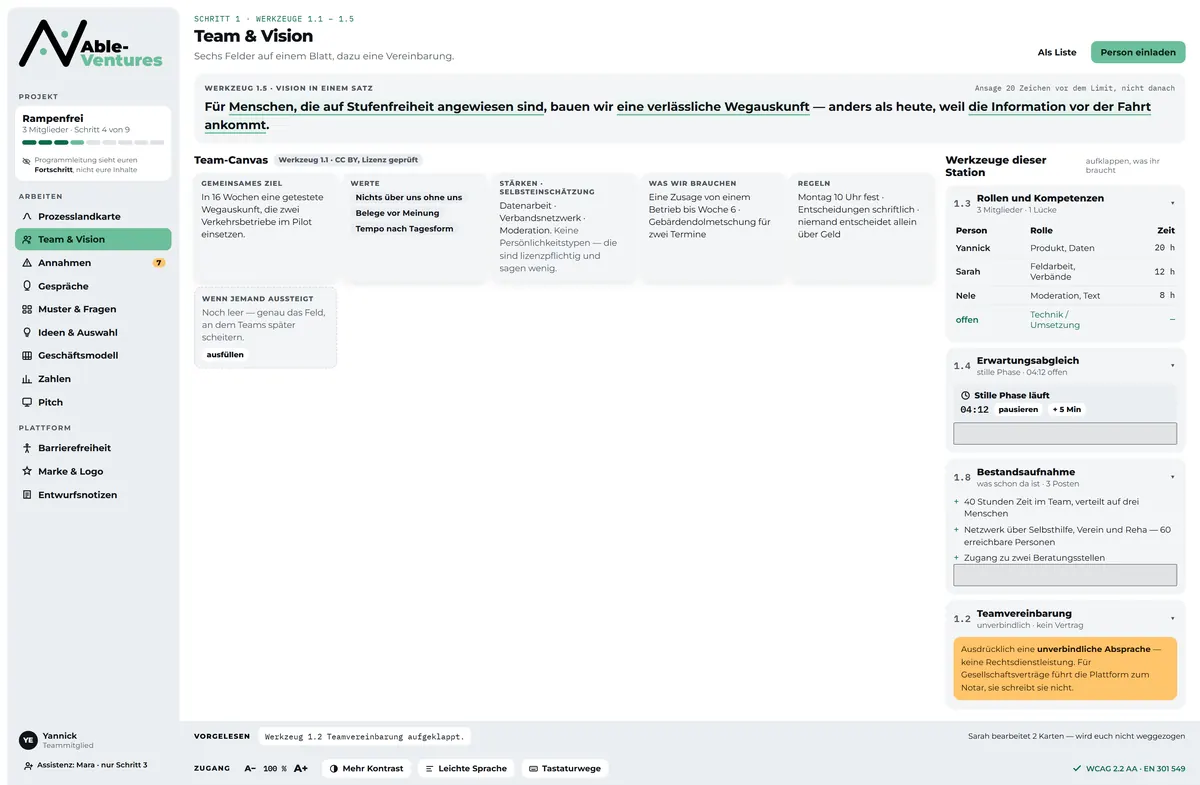
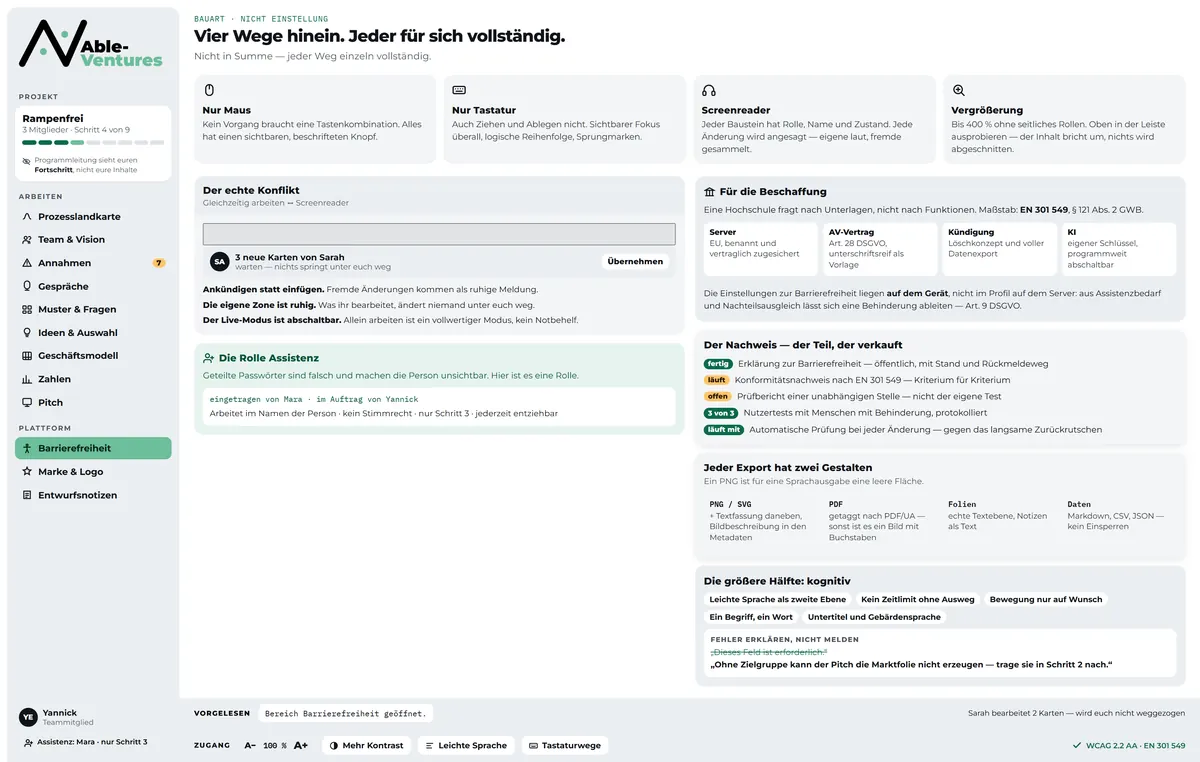
The screenshots show the German interface of the software; there are no English ones yet.
Where this stands right now
No start date, no cohort, no application process. What there is: a list — and every entry on it is part of an answer to an open question.
It isn't the content that's missing, it's the way in.
Three ways
Eight 60-minute sessions across 16 weeks, online — more if you like. One team, matched by sector or founding experience.
Get in touchPersonal assistance, social law, accessibility — you contribute the expertise, for example to the block on assistance and applications in week 10.
AskThe box headed „In short“ is meant to be forwarded. More material is in the works.
ContactAble-Ventures is an accelerator for disabled people who want to start a company — sixteen weeks, online, no fee and no equity.
It comes with mentoring, a fixed cohort and tools that everyone can use.
For investors and funders
Partnerships carry the programme at first, later licences for the software sold to universities, startup centres and companies. That is why teams never pay.
90tools for nine steps, each one described
77methods the programme draws on
4competitor fields examined, with prices and sources
Next milestone
A first tool as the MVP, chosen through this comparison with existing tools.
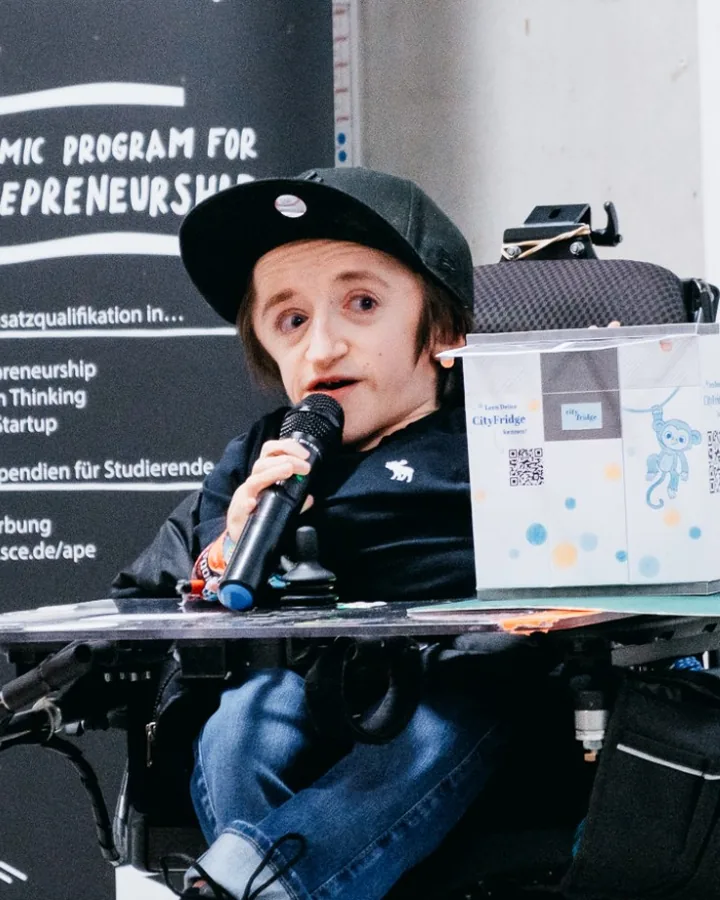
Who's behind this
Yannick Andricek, 25, from Munich. I am building Able-Ventures because I use the tools that come out of it myself.
I know what it is like to sit in a programme that was built for somebody else. That is why nothing here is made accessible afterwards — it is cut differently from the start.
Solo Being built Looking for a co-founder
No application, just a list
Whether you want to found something yourself or to support: sign up, and I will get in touch as soon as this gets going. No application, no procedure — a list and a message when there is something to say.
You will get a confirmation email — you are only on the list once you click the link in it. Unsubscribe any time. No trackers, no cookies, no banner. The only thing stored in your browser is whether you changed the text size or the contrast.